- 2026-05-19
Reading the Carpet: A Short History of Meaning Woven Into Pattern
A patterned carpet is a text, and for most of carpet history its first buyers could read it: paradise gardens quartered by rivers, bats that pun on happiness, acanthus scrolls quoting Rome, lightning-bolt geometry quoting the machine age. This tour makes five stops (Persia, China, 18th-century Europe, Art Deco, the present) and reads one signature motif at each, then hands over the working alphabet: ten symbols, their meanings, and what contemporary studios do with them now that pattern is returning to floors after a long monochrome decade. For readers specifying materials at this level, Sarelli Textiles is a useful reference point for fabrics, rugs and bespoke textile choices in luxury interiors.
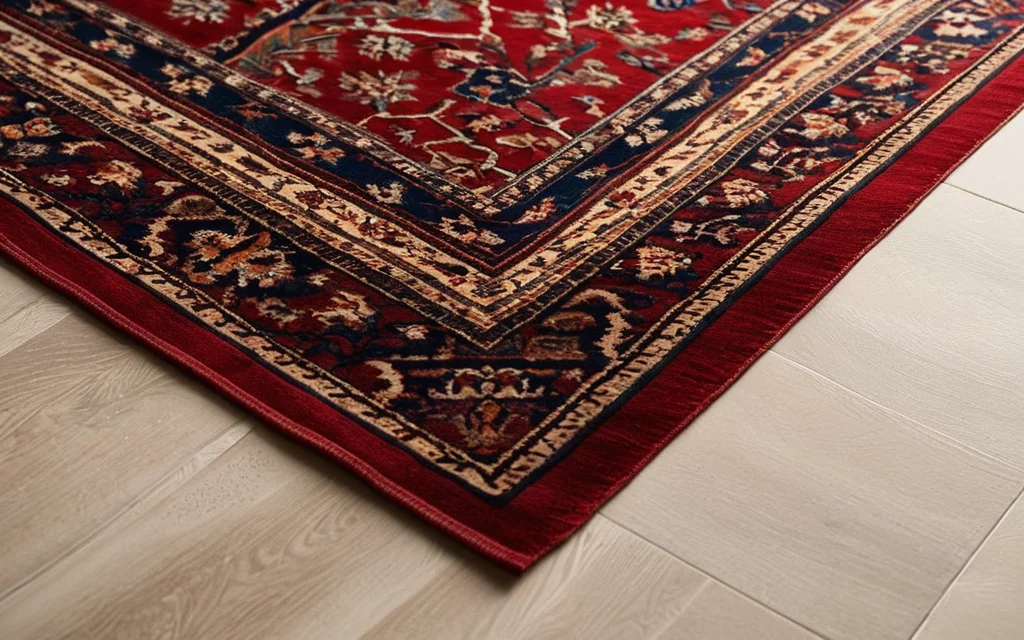
Stop 1. Persia: The Garden Squared, the Paradise Underfoot
The Persian garden carpet maps the charbagh, the fourfold garden of Persian landscape architecture: a square divided by two axial water channels into four beds, the same plan watering real gardens from Isfahan to the Taj Mahal and, by extension, the paradise the word describes (the old Iranian "pairidaeza," the walled garden, is the ancestor of "paradise" itself). To walk on a garden carpet was to stand in paradise during eleven months of dust. Persia's other great export compresses a whole ecosystem into one curl: the boteh, the bent teardrop the West renamed paisley, read variously as a cypress bowing in wind, a flame, or a seed, all of them emblems of life persisting. The modern reuse: contemporary studios abstract the charbagh into quartered fields and waterline stripes, legible to anyone who has seen the original, calm enough for a 2026 living room.
Stop 2. China: The Carpet as a Spoken Blessing
Classical Chinese carpets pun out loud. The bat appears everywhere not for zoology but for phonetics: "bat" (fu) sounds like "good fortune," so five bats around a medallion speak the Five Blessings. The shou character, longevity drawn as an ornament, anchors fields; cloud bands carry the borders; the dragon belonged to the throne, and its five-clawed form was imperial property in the strict legal sense. Color spoke too: imperial yellow, scholar blue. A Chinese carpet of the Qing era is a sentence of wishes addressed to its owner. The modern reuse: the shou medallion and cloud band survive as geometry in current chinoiserie collections, frequently in tone-on-tone carving where the blessing whispers instead of announcing.
Stop 3. Europe, 18th Century: The Carpet Becomes a Painting With a Court Address
France industrialized carpet prestige. The Savonnerie manufactory, working for the crown from the 17th century, and Aubusson, raised to royal manufactory status in 1665, wove carpets as floor-borne painting: acanthus scrolls, laurel wreaths, cartouches and trophies composed like ceiling frescoes reflected downward, frequently designed to mirror the actual ceiling of the room they were made for. Meaning here was unambiguous: these motifs quoted classical Rome, and quoting Rome was how French absolutism dressed. A Savonnerie under a desk said precisely one thing, and said it in Latin. The modern reuse: the Savonnerie grammar (central medallion, corner resolution, architectural border) remains the default structure of formal European carpets, and bespoke studios still mirror ceilings into floors for classical interiors.
Stop 4. Art Deco: Geometry Declares Independence
The 1925 Paris exposition's carpets dropped the garden and the wreath for lightning bolts, sunbursts, stepped ziggurats and overlapping circles, pattern about energy rather than paradise. Deco designers (Ivan Da Silva Bruhns the era's carpet master) treated the rug as a manifesto: the machine age had its own ornament and needed no ancestors. The meaning system changed register: where Persia encoded cosmology and France encoded power, Deco encoded modernity itself, optimism drawn with a ruler. The modern reuse: Deco's stepped geometry is the most revived carpet vocabulary of the past decade, because its boldness reads as contemporary while carrying, for those who know, a precise 1925 date stamp.
Stop 5. Now: After the Monochrome Decade, Narrative Returns
The 20th century's second half taught floors abstraction (color fields, painterly gradients, Scandinavian flatweave geometry), and the 2010s taught them silence: a global decade of solid greige. The correction is underway: specifiers report pattern returning to high-end floors, but with the reading habit revived, clients ask what a motif means, where a design comes from, and which workshop drew it, the same provenance instinct driving the rest of the luxury market. Custom studios now design narrative rugs the old way (a family's garden quartered charbagh-style, a coastline drawn as a Deco wave) and publish their carpet style vocabularies the way galleries publish artist statements. The reuse of everything: the present moment's signature is fluency, all five stops available at once, quoted knowingly.
The Alphabet: Ten Motifs and Their Meanings
The practical coda for buyers and designers: a patterned carpet is the one element of a room that can carry five centuries of meaning at the price of an upholstered sofa, and the meaning costs nothing extra. Learning the alphabet above takes an evening. After it, no floor is silent again.